If you go by LinkedIn, outbound email is a must-have. But talk to most people who've actually tried it, and for most of them it's been a goose egg.
It works for about 1 in 4 of my clients. Whether it works depends on the category and the offer. When it does, its fixed, low cost beats paid ads for business-to-business (B2B) sales.
So at minimum, test it. A fair test needs 1,000 to 3,000 targeted contacts and 30 to 60 days, and costs about $3,350 to $4,550 all in. Plan for about 4 weeks of inbox warmup before the first email goes out, which adds about $206 in tools. To make it work, focus on the 4 things below.
The result
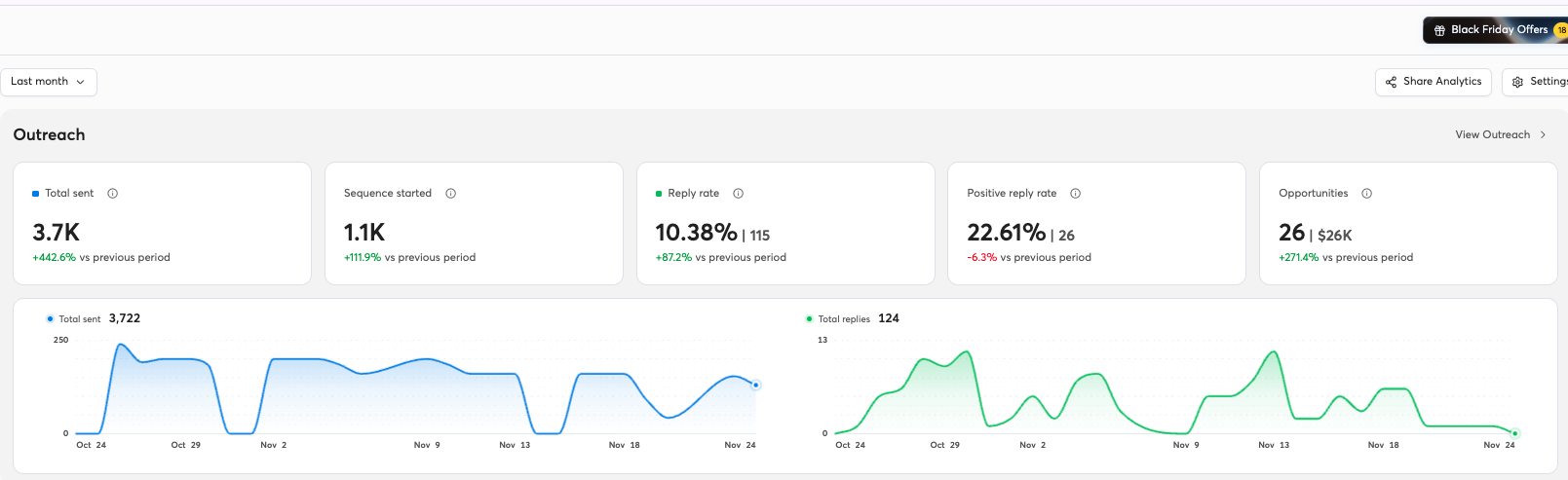
The client is an education technology company that works with universities, private high schools, students and parents. This campaign targeted private high schools. Results from Oct 24 to Nov 24, 2026:
| Measure | Result | vs. previous month |
|---|---|---|
| Emails sent | 3,722 | +442.6% |
| Reply rate | 10.38% of contacts replied (115 replies) | +87.2% |
| Positive reply rate | 22.61% (26 of 115 replies) | -6.3% |
| Opportunities | 26 | +271.4% |
| Cost per opportunity | $46 ($129 with setup) | |
| Bounce rate | 0.75% |
At $5,000 per opportunity, that is $130,000 in pipeline. We started with a $1,000 placeholder per opportunity because we didn't know the deal value yet.
The cost, compared with LinkedIn ads
Outbound cost $1,206 a month plus $2,140 to set up. That works out to $46 per opportunity at last month's pace, or $129 if you load the setup costs into the first month. A 30-day test costs $3,346 (setup plus 1 month). A 60-day test costs $4,552.
| Item | One-time | Monthly |
|---|---|---|
| Setup (me) | $2,000 | |
| MoltSets and Apollo.io setup | $140 | |
| Management (me) | $1,000 | |
| Instantly (Hyper Growth plan) | $107 | |
| Zapmail, 27 sending inboxes (estimate) | $99 | |
| Total | $2,140 | $1,206 |
Not included: domain fees.
| Outbound (this client) | Targeted LinkedIn ads (benchmarks) | |
|---|---|---|
| What you get | An opportunity: a school leader asks to talk or see more | A lead: someone fills in a form |
| Cost per result | $46 per opportunity ($129 with setup) | $202 per lead, B2B average; $376 for the typical advertiser; about $64 in education |
| What $1,206 a month buys | 26 opportunities (actual) | About 6 leads at $202, or about 19 at $64 |
A LinkedIn lead is not yet an opportunity. If 12% to 22% of LinkedIn leads become opportunities, each opportunity costs $450 to $1,200. On that basis, outbound's $46 to $129 per opportunity is well below LinkedIn's estimated $450 to $1,200.
LinkedIn sources: Metadata 2026 B2B Paid Media Benchmark ($202 per lead), Webtonic ($376 median), Webtonic, education ($64), Stackmatix (lead-to-opportunity rates).
The 4 things to focus on
First, category and offer fit. The buyer can be named and found (school leaders). The problem is already part of their job. The offer is specific and hard to get elsewhere. The best-known schools, which already had what we offered, said no.
Second, research on who to target, not just first lines. We wrote custom first lines from each school's news for a small first wave. It got replies but no opportunities, though it was too small to judge. All 26 opportunities came from targeting: the right title, the right type of school, one campaign per region sent in local business hours, and the offer that fit each region.
Third, a clean list. One region's raw file went from 1,427 rows to 239. We verified emails with Instantly and MoltSets (one check of 548 leads removed 43 bad emails), replaced contacts that bounced, and never emailed a school twice. Bounces fell from 3.9% in the first days to 0.75%.
Fourth, conversational questions. Email 1 ends with one easy question, not a pitch: "How does [school] handle [problem] today?" Email 2 gives proof and asks permission to send more. Nearly all of the 26 opportunities came from replies to email 1 or 2.
The AI setup
I ran the whole program with AI, which made both the setup and the day-to-day management easy. Claude connects straight to Instantly through Model Context Protocol (MCP), alongside Zapmail for sending inboxes and Apollo.io for contacts. Instantly sent the emails, and Instantly and MoltSets verified every address before it went out. Through that connection, Claude loaded and cleaned lead lists, verified emails, wrote and edited the email sequences, drafted replies from templates and pulled the reports. I rarely had to log in to the tools myself.
Stay within the law
Cold email is allowed in most countries, but each country sets its own rules. Check the rules where your recipients are before you send, and get legal advice if you're unsure. I'm not a lawyer.
Every email should say clearly who it's from: a real name, the company and contact details. Use an honest subject line and accurate sender details. And give an easy way to opt out. We ended every email with "If you no longer wish to receive emails, please reply 'stop'."
Honor every opt-out quickly and for good. In the United States (US), the CAN-SPAM Act (Controlling the Assault of Non-Solicited Pornography and Marketing Act) covers business-to-business email too. You must honor opt-outs within 10 business days, and include a physical postal address. Federal Trade Commission guide
Hong Kong's Unsolicited Electronic Messages Ordinance requires honoring unsubscribe requests within 10 working days. Hong Kong Education Bureau FAQ
Canada's Anti-Spam Legislation (CASL) requires consent. A business email address the person published themselves can count as implied consent, but only if the message relates to their job. Canadian regulator's guidance
We added every "stop" reply to Instantly's blocklist, so no inbox on the team could email that person again.
Sources: Instantly reports and campaign data, Oct 24 to Nov 24, 2026, pulled Nov 24, 2026. List-cleaning figures come from earlier working sessions, Oct 11 to Nov 22, 2026.
Want help testing whether outbound fits your category and offer?
Let’s Chat →